
Stewart Projected and Actual Release
A projected date is a calculated milestone based on the sentence documents and the law that applies to that case. It can be useful for planning, but it does not confirm departure from custody. Tennessee FOIL uses the exact labels Release Eligibility Date and Sentence End Date. Release Eligibility Date is the earliest computed point at which the person may become eligible for parole or another applicable release route. Sentence End Date is the calculated endpoint of the sentence. Those fields can differ.
Actual release requires proof that custody changed. Read the current Supervision Status and Assigned Location, then seek the release certificate, authorization, jail exit record, or supervising-office confirmation. A person can reach an eligibility date and remain incarcerated after a Board decision. Someone can also finish one sentence and transfer under a detainer. A court order may authorize release before the jail completes its checks.
Stewart Release Dates by Custody
The correct source turns on where the person is held and why. The Stewart County Detention Center houses local detainees and sentenced people, while TDOC manages state felony sentences and state institutions. No state prison was found inside Stewart County. Federal and immigration dates belong to separate systems.
| Situation | First record | What the date means |
|---|---|---|
| Pretrial Stewart detainee | Bond and court orders, then jail record | No fixed sentence release date; another hold can still block departure |
| Short local sentence | Judgment and Stewart jail release record | Court term explains authority; jail record supplies physical exit |
| TDOC felony sentence | FOIL and TDOC Sentence Information | Eligibility and sentence-end calculations, not automatic release promises |
| County-jail felony of one year or more | TDOC County Jail Sentence Information route | TDOC calculates qualifying sentence dates even if housed locally |
| Federal sentence | BOP locator and federal judgment | A future BOP date is projected; a past Released result means departure from BOP custody |
For a Stewart booking, disappearance from the live roster does not prove release. It can mean transfer, a stale display, an older intake outside the booking-log window, or movement to another authority. The Stewart County released-inmate search joins jail, court, state, and federal records when the custody path is unclear.
Find Stewart Projected Release Dates
Start with an official source and keep the labels intact. TDOC's Felony Offender Information Lookup, or FOIL, includes current and former felony offenders in state custody or supervision. It may show a photograph, identifying data, Supervision Status, Assigned Location, Sentence Begin Date, Sentence End Date, Release Eligibility Date, Parole Hearing Date, Parole Hearing Result, and active Tennessee sentences.
- Identify whether the person is pretrial, serving a local sentence, serving a state felony sentence, or in another system.
- For a state case, open the official FOIL launch page and search by committed name. Add birth information or a TDOC or TOMIS number when known.
- Match the correct record using the photo, identifiers, offense, and location. Read Supervision Status and Assigned Location before dates.
- Record the exact Release Eligibility Date and Sentence End Date. Do not rename either field as an actual release date.
- Review active sentences and parole-hearing fields. Multiple or consecutive terms can change which date controls.
- For a felony offender housed in the county jail, use TDOC Sentence Information and select Offender Information, County Jail, Sentence Information.
- For a short Stewart sentence, request the judgment and release record from the court and jail rather than forcing the person into FOIL.
The official FOIL search interface shows the state lookup used for this workflow.
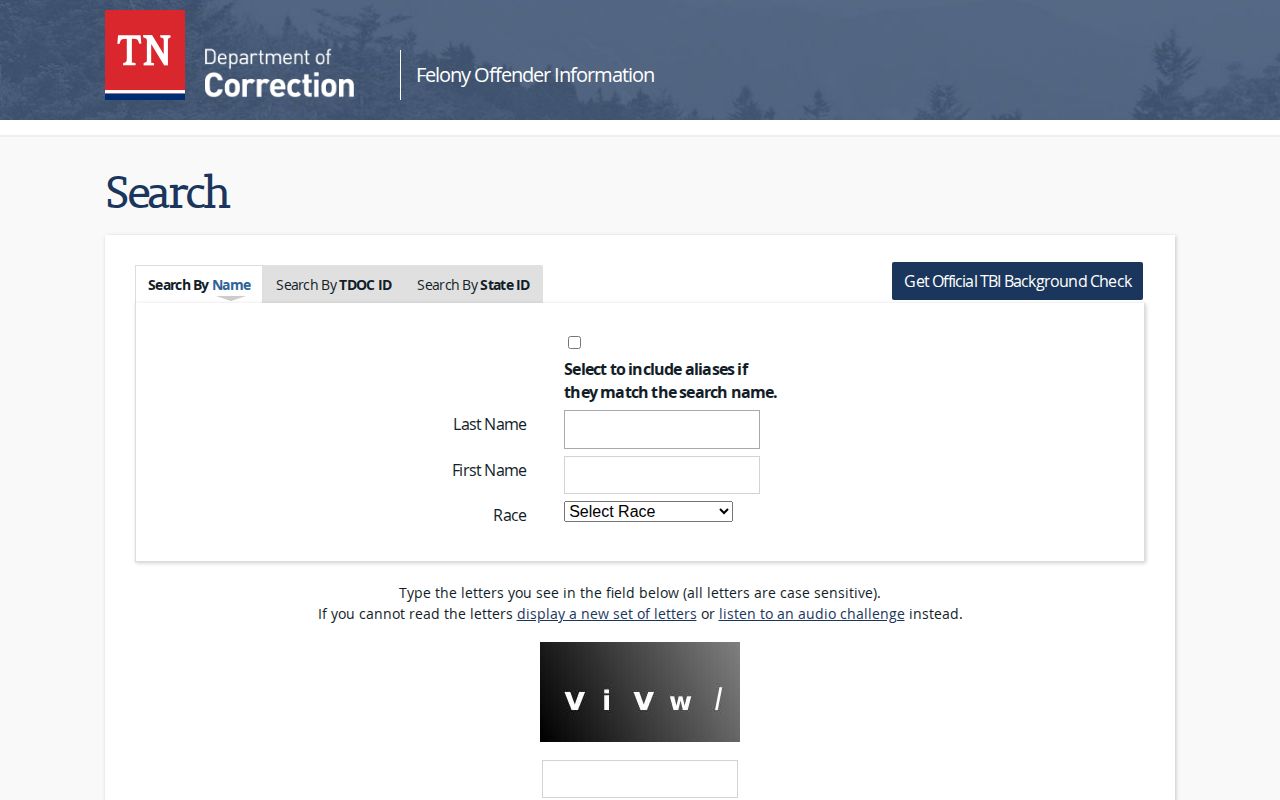
The search screen is only the start. Identity matching and the detail record prevent a similar name from being tied to the wrong sentence dates.
Note: FOIL concerns felony offenders and state supervision, not every brief Stewart County jail booking.
Stewart FOIL Release Date Fields
FOIL warns that dates may change as additional court documents arrive. That notice is central to reading the result. A corrected judgment, added jail credit, or a ruling on concurrent versus consecutive sentences can alter the computation. The displayed detail should be saved with its access date and later checked again when timing matters.
| FOIL field | How to read it |
|---|---|
| Supervision Status | Shows incarcerated, probation, parole, inactive, or another reported status |
| Assigned Location | Helps distinguish custody from community supervision |
| Sentence Begin Date | Start point used in the displayed state sentence record |
| Release Eligibility Date | Computed eligibility milestone, not a Board grant or door-exit time |
| Sentence End Date | Computed sentence endpoint, which can differ from release eligibility |
| Parole Hearing Date and Result | Shows Board process; a grant can still precede physical release |
The FOIL detail interface is the source for these exact public labels.
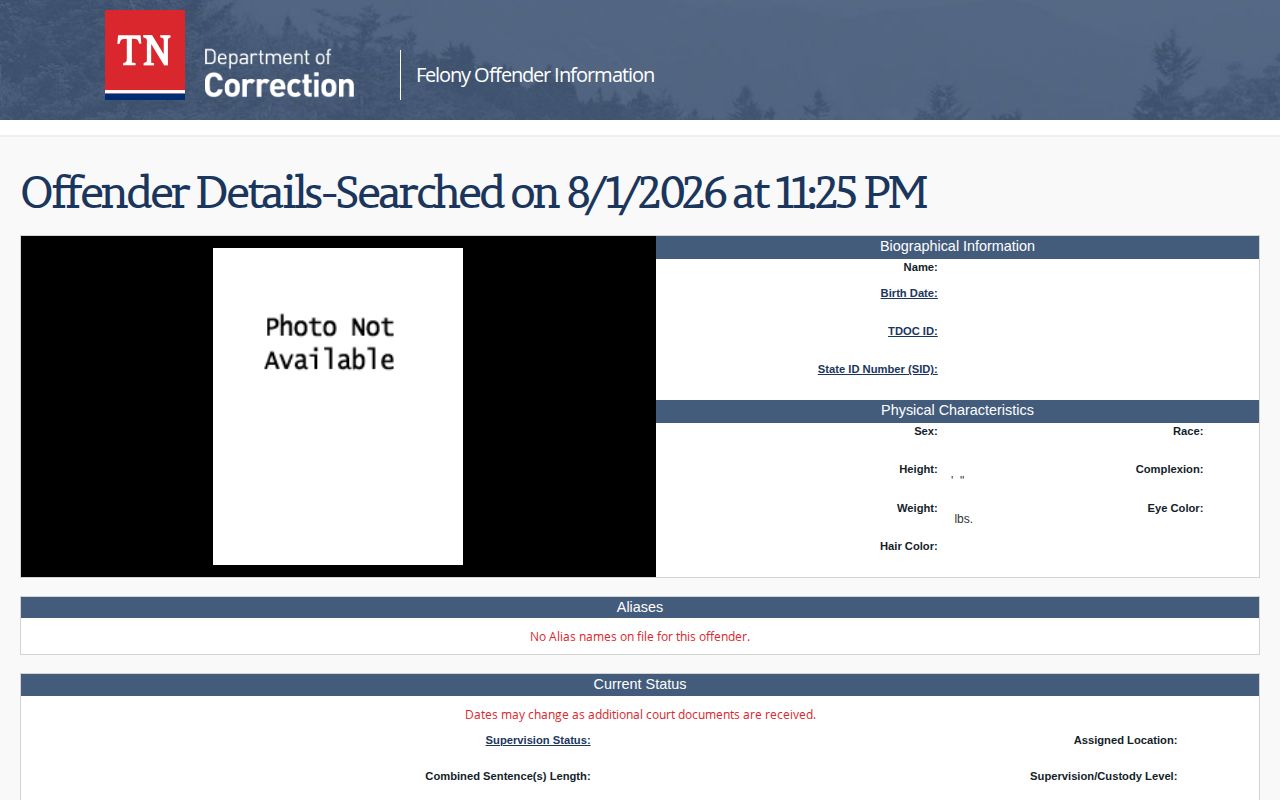
The detail view puts eligibility, sentence end, status, location, and parole information in one state record, yet a formal release document remains stronger proof of departure.
Stewart Credits and Release Eligibility
There is no safe universal formula for a Tennessee release date. Tenn. Code Ann. § 40-35-501 contains several eligibility rules tied to the offense, offense date, offender range, sentence, and later amendments. General sentencing ranges include percentages such as 20 or 30 percent for especially mitigated cases, 30 percent for Range I, 35 percent for Range II, 45 percent for Range III, and 60 percent for career offenders, subject to the exact judgment and lawful credits. Other subsections impose different offense-specific rules.
The common claim that everyone serves 85 percent is wrong. Some regimes require service at 100 percent less allowed credits but bar reduction below 85 percent. Other named offenses use an 85-percent threshold. For specified offenses committed on or after July 1, 2022, the Truth in Sentencing Act added rules requiring 100 percent without sentence-reduction credits shortening the term. In those cases, credits may affect privileges or classification.
Tenn. Code Ann. § 41-21-236 governs sentence-reduction credits. Their effect depends on the offense date, conviction, term, program performance, conduct, forfeiture or restoration, and limits in § 40-35-501. No date should be produced by multiplying a sentence by 85 percent.
Stewart County Jail Date Calculation
One Stewart-specific wrinkle crosses the jail and state systems. Tenn. Code Ann. § 41-21-1006 assigns TDOC responsibility for calculating sentence expiration and earliest release for felony offenders sentenced to TDOC and felony offenders sentenced to a county jail or workhouse for one year or more. A person can therefore need a state sentence computation while physically serving the sentence in Stewart County.
Use the TDOC Sentence Information route for that case. Select the county-jail option and ask for the existing computation and release documents. A short misdemeanor sentence is different. The Stewart court judgment establishes the term, while the detention center record confirms the actual release date and time. The jail cannot be replaced by FOIL when the person never entered the state felony system.
The TDOC Sentence Information page documents the separate state-prison and county-jail paths.
Note: The place of custody does not always identify who calculated a Tennessee felony sentence.
Why Stewart Release Dates Change
Dates can move, or two valid dates can answer different questions. Eligibility opens a decision point. Sentence end marks a calculated endpoint. Neither alone accounts for every new document, hold, or agency action that may arise before departure.
| Factor | Possible effect | Record to check |
|---|---|---|
| Late or amended court documents | Changes credits, sentence start, or concurrent and consecutive treatment | Judgment, amended order, FOIL update |
| Credits and discipline | Moves eligibility or expiration only as the governing law permits | TDOC sentence computation |
| Multiple sentences | Combined ineligibility periods may control over one charge's date | Active sentences and full judgment set |
| Detainer or new case | Causes transfer or continued custody after one sentence ends | Release checklist, court and receiving-agency record |
| Parole action | Grant, denial, deferral, or rescission affects the release path | Board final action and FOIL status |
| Local processing | Creates a gap between legal authority and physical door-exit time | Stewart jail release record |
Stewart Parole Dates Are Conditional
A Release Eligibility Date does not compel the Tennessee Board of Parole to grant release. Tenn. Code Ann. § 40-35-503 governs the Board's decision standard. A hearing officer can make a recommendation, while Board members issue the action. The result can be grant, denial, deferral, or another case-specific outcome.
Even a grant is not a physical-release timestamp. TDOC states that the probation or parole office must approve a release plan, which addresses the proposed place to live and work. Detainer checks, pre-release conditions, a new sentence, or rescission can intervene. Read current FOIL status and location, then obtain the release certificate when exact proof is needed.
Confirm Stewart Actual Release Dates
For a state offender, TDOC Sentence Information or Archived Records can supply the computation, release checklist or certificate, letter of expiration, and release authority. The archived request should identify the offender by full name, TOMIS or TDOC number, date of birth when known, and the exact records sought. TDOC warns that archive-search charges may apply after notice and says not to prepay. Records Management lists 615-253-8079 for questions.
The formal TDOC release workflow tracks more than the two dates shown in FOIL. Policy 511.03 uses sentence effective and expiration information, release eligibility or maximum-sentence data, current custody, release authority, detainer checks, and the staff action that processed release. Asking for those existing records can explain why a public calculation changed or why an eligible person did not leave on the expected day. TDOC Archived Records Management accepts portal requests and mail at the Rachel Jackson Building, second floor, 320 Sixth Avenue North, Nashville, TN 37243-0465.
For a Stewart jail sentence, use the county records route to request the judgment and the release date, time, and authority from the Sheriff's records clerk. The Sheriff's contact page provides the detention center lines. For a pending event, Tennessee SAVIN or VINE can provide an alert, but it remains a custody-event feed. The Stewart County VINELink inmate search explains county and state alert coverage. Always confirm an alert with the reporting jail or TDOC.
General Sessions is usually the first local source for misdemeanors, initial bond, and many probation matters. Circuit or Criminal Court handles felony judgments after bind-over or indictment. Both clerk functions are at 225 Donelson Parkway in Dover but have distinct contacts and records. Use the official Stewart court contacts to ask which court owns the case, then request the judgment, docket, sentence, bond or release order, and any revocation or amended order. The order explains legal authority; the detention center's release record supplies the actual exit time.